
Most people who hit their head recover on a fairly predictable timeline. The headache fades, the fog lifts, and within a few weeks life goes back to normal.
But some people don’t follow that script. Weeks turn into months. The dizziness lingers. Simple things- a busy grocery aisle, scrolling on a phone, standing up too fast- leave them wrung out. They’ve had the scans. The scans came back clean. And they’re left with the uncomfortable impression that nobody can quite explain what’s happening to them.
If that describes you or someone you love, there may be a piece of the picture that hasn’t been looked at yet: how the upper neck is functioning, and whether connective tissue laxity is quietly making everything harder.
Two systems that share a neighborhood
The junction where the head meets the neck is unusually busy. The upper cervical spine (C1–C3) sends dense sensory information into the brainstem, and it shares that destination with the trigeminal nerve, the nerve responsible for sensation across the face, jaw, and much of the head.
Those inputs converge in a region called the trigeminocervical nucleus. Because they arrive at the same place, the brain doesn’t always keep them neatly separated. That convergence is one of the reasons neck problems, headaches, facial and jaw symptoms, and eye pain so often show up together in the same person. It isn’t a coincidence, and it isn’t imagination; it’s anatomy.
The upper cervical region also feeds structures involved in balance and automatic body regulation: the vestibular nuclei, the nucleus tractus solitarius, the vagus nerve’s motor nucleus, the reticular formation. Signals from your neck are part of how your nervous system answers a very basic question, thousands of times a day: where is my head, and is everything okay?
Why hypermobility changes the math
People with hypermobile or lax connective tissue have less passive stability. Ligaments that would ordinarily hold a joint in place give more than they should. That has consequences in two directions at once.
In the neck, the small stabilizing muscles have to work harder to make up the difference. Fatigue, guarding, and tightness follow. And because those muscles are also densely packed with position sensors, muscles that are working overtime tend to send noisier, less reliable information upstream. When what the eyes report, what the inner ear reports, and what the neck reports don’t quite agree, the nervous system has to resolve the mismatch. That resolution has a cost, often felt as dizziness, visual motion sensitivity, brain fog, or a vague sense of being unsteady.
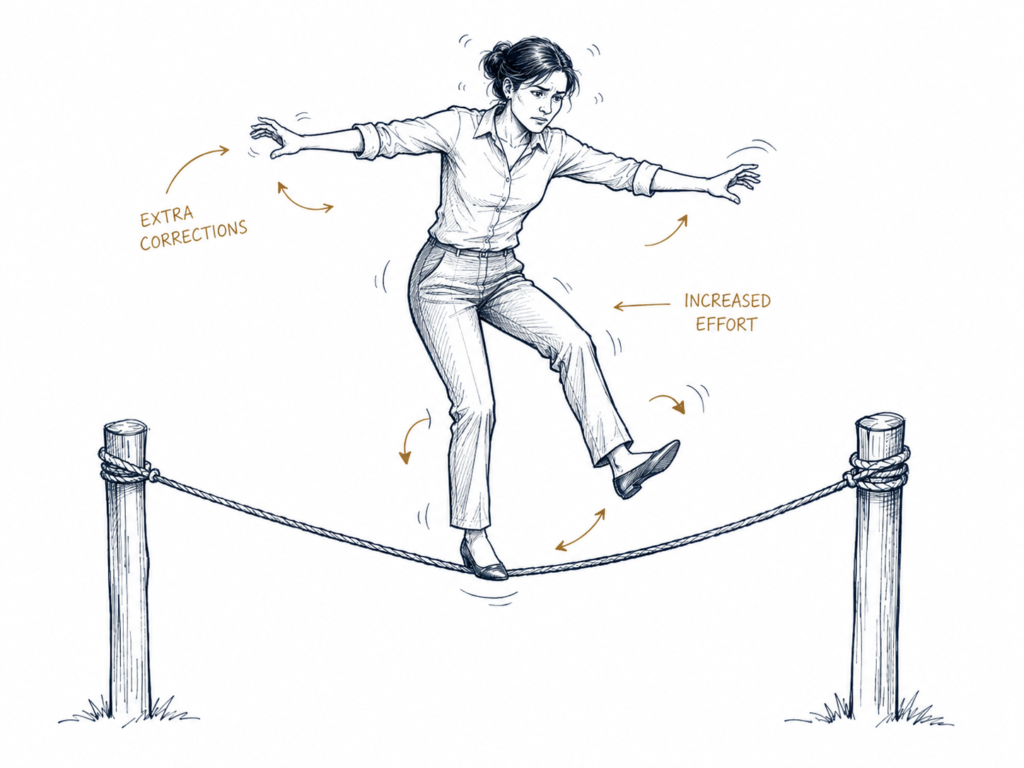
In the circulatory system, more compliant vessels can allow blood to pool in the legs and abdomen when a person stands. Less blood returning means less pumped out, and the body compensates by ramping up sympathetic activity — the heart rate climbs, the system braces. Lightheadedness, fatigue, palpitations, and poor exercise tolerance often go along with that.
Neither loop stays in its lane. Both raise the nervous system’s overall level of alarm, and each one makes the other harder to settle. Add a concussion, a sudden neurological insult on top of a system that was already working with a thin margin, plus ordinary stressors like poor sleep, illness, or a demanding season of life, and you have conditions where symptoms are far more likely to persist. Vulnerability, injury, and stress converging is a very different problem than any one of them alone.
The words patients use are clinical information
There’s a particular vocabulary that shows up over and over with these patients:
- I feel disconnected.
- My head feels heavy.
- I don’t know where my neck is.
- I feel like I’m floating.
- I don’t trust my body.
These descriptions get dismissed as vague. They aren’t. They’re what altered sensory processing feels like from the inside, and they point toward the upper cervical spine. When someone struggles to describe their symptoms in the language of pain, it often means the problem isn’t primarily a pain problem.
Where upper cervical care fits
Upper cervical chiropractic doesn’t treat concussion, and it doesn’t change anyone’s connective tissue. What it addresses is the quality of the information the upper neck is sending.
If the atlas isn’t sitting well, if there’s misalignment, altered loading, muscle dysfunction, and irritation in a region that is supposed to be a reliable sensory reference point, then the nervous system is trying to integrate a noisy signal. Improving alignment in that area is aimed at reducing mechanical strain and improving the accuracy of the input, which may support better integration, steadier balance, and improved symptoms for some people.
The gentle, precisely measured approach used in Orthospinology is important. Hypermobile patients don’t need more movement introduced into joints that already move too much; they need accuracy and stability. Corrections are based on individual imaging and analysis, delivered with a very small amount of force, and repeated only when they’re actually needed.
Complex cases need a team
Nobody should hear that one provider can address all of this, and we won’t tell you that. The patients who do best in this category are usually the ones surrounded by a collaborative group with Upper cervical care as one piece of that. It’s a meaningful piece when the upper neck is involved, and that’s exactly what an evaluation is for.
If this sounds like your situation
The most useful question isn’t “what’s my diagnosis.” It’s “which systems aren’t working together, and why.” If you’re in Waco, Woodway, or the surrounding area and you’ve been dealing with headaches, dizziness, brain fog, or neck symptoms that haven’t improved on the expected timeline — particularly if you’re hypermobile, or your symptoms started after a head or neck injury — an upper cervical evaluation can tell you fairly quickly whether this is part of your picture.
Reviewed by Dr. Christy Flick, DC · Last reviewed August 2026
This article is for educational purposes and shares general information about upper cervical chiropractic care. It isn’t a substitute for an individual clinical assessment, and results vary from person to person. If you’re wondering whether this could be the source of what you’re dealing with, we’d welcome the chance to take a look — schedule a complimentary consultation at atlaschiropracticwaco.com or call 254-304-7474.
About the Author