
If you have been under care for a few months, there is a question that tends to show up somewhere around visit twenty. You feel better. Your headaches are further apart. You slept through the night for the first time in years. And then you have a thought:
What’s actually changing in my neck?
It is a fair question, and it deserves a real answer instead of reassurance. A study published in the Journal of Upper Cervical Chiropractic Research, August 2026, takes a look at exactly that question, and it is worth walking through.
What the researchers did
Two doctors, Scott Baker, DC, and Joel Alcantara, DC, PhD, went back through a year of patient files at an Upper Cervical practice using the Blair technique. Blair is a cousin of the technique used here at Atlas (SOCO or Orthospinology). Both are Upper Cervical methods, meaning care begins at the very top of the neck with the Atlas (C1) vertebra, and both rely on precise imaging rather than guesswork.
The study reviewed 45 patient files, 25 women and 20 men, with an average age of 52. After incomplete records were removed, 38 files had a full set of measurements. Each patient’s X-rays were measured at four points in time: at their first visit, then again at 3 months, 6 months, and 12 months of care.
The researchers measured three things:
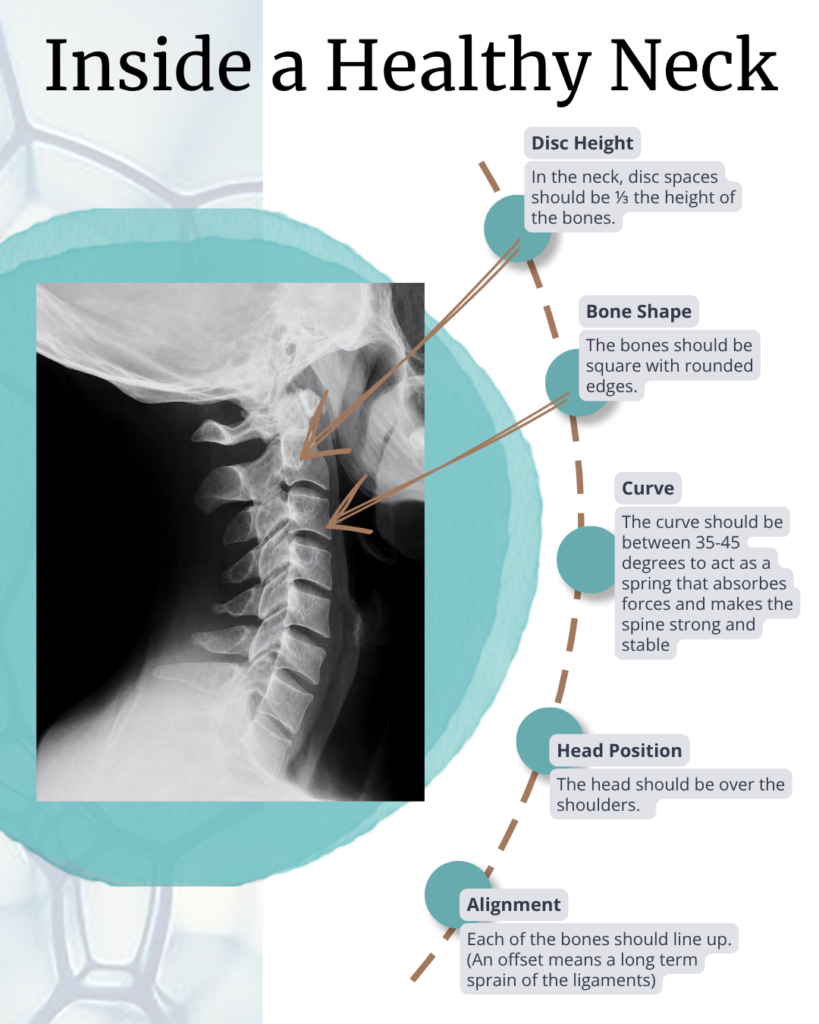
- Intervertebral disc height. The disc is the cushion or “space” that sits between each pair of vertebrae. Disc height is how tall that cushion measures on an X-ray.
- Anterior head translation. This is how far forward your head sits relative to your shoulders. It is the technical name for what most people call forward head posture.
- Cervical lordosis. The gentle curve in your neck that acts like a shock absorber and adds strength and stability to your spine.
What they found
Disc height increased, and the increase was statistically significant. Average disc height measured 4.60 mm at the first visit and 6.52 mm at the twelve-month mark, an increase of roughly 42 percent. Each functional unit was measured, and all showed improvement from the first visit through the twelve-month mark.
Disc height in the neck typically decreases over time. Discs lose water content and lose height as we age, and this group averaged 52 years old, which is squarely in the window where you would expect to see gradual loss in disc space. Seeing the measurement move the other direction over twelve months is not what we would expect over time.
The other two measurements did not reach statistical significance. Anterior head translation changed by an average of 1.45mm over the year, and cervical lordosis changed by an average of 8.24 degrees. An 8.24 degree change in curve is meaningful clinically, but the variation from patient to patient was wide enough that the result did not reach statistical significance, which means this part of the study cannot support firm statements in either direction.
The authors also looked at how the three measurements moved in relation to each other, and found that by twelve months, lordosis and disc height were changing in a linked pattern. Their interpretation was that the cervical spine appears to respond as a connected unit over a course of care rather than through one isolated compensation.
The limits of this study
There was no control group. Nobody compared these 38 patients to a similar group of 52-year-olds who received no care at all. Without that comparison, the study can show that measurements changed during care, but it cannot show that the care is what changed them.
It was retrospective. The researchers looked backward through existing files rather than designing a study in advance. Retrospective reviews are useful for spotting patterns worth investigating.
The sample is small. Thirty-eight complete records are enough to detect a strong signal and not enough to fully settle a research question.
Despite these limits, the study shows a documented, measurable structural change in a group of patients over a year of Upper Cervical care, published in a peer-reviewed journal, pointing toward something that deserves a larger and better-designed study.
Why this matters for your care at Atlas
Every problem has a cause. That conviction is the whole reason your first visit here starts with precise imaging rather than a general adjustment, and it is why your Blueprint Spinal Analysis exists in the first place. We never guess about your spine, because guessing is how people end up spending years managing a symptom instead of correcting what is producing it.
This research speaks directly to something you may have wondered about the length of a corrective care plan. Full correction takes 18 to 24 months, and that number surprises people who arrive hoping for a quick fix. The reason is biological. Ligaments, the tough bands that hold your vertebrae in position, remodel slowly. The collagen fibers inside them mature over many months. Anything less than full correction is unstable and more likely to relapse. A study that measures change at 3, 6, and 12 months and finds the disc measurements still moving at the twelve-month mark is consistent with that timeline. Structural change is slow because your body’s structural tissue is slow to repair, especially after an injury that’s built up over years.
It also explains why your care includes regular recalibration rather than a single before-and-after image. Progress that unfolds over a year is progress you would never notice from the inside. You would only notice how you feel, which is wonderful and which is also not the same thing as knowing what your spine is doing.
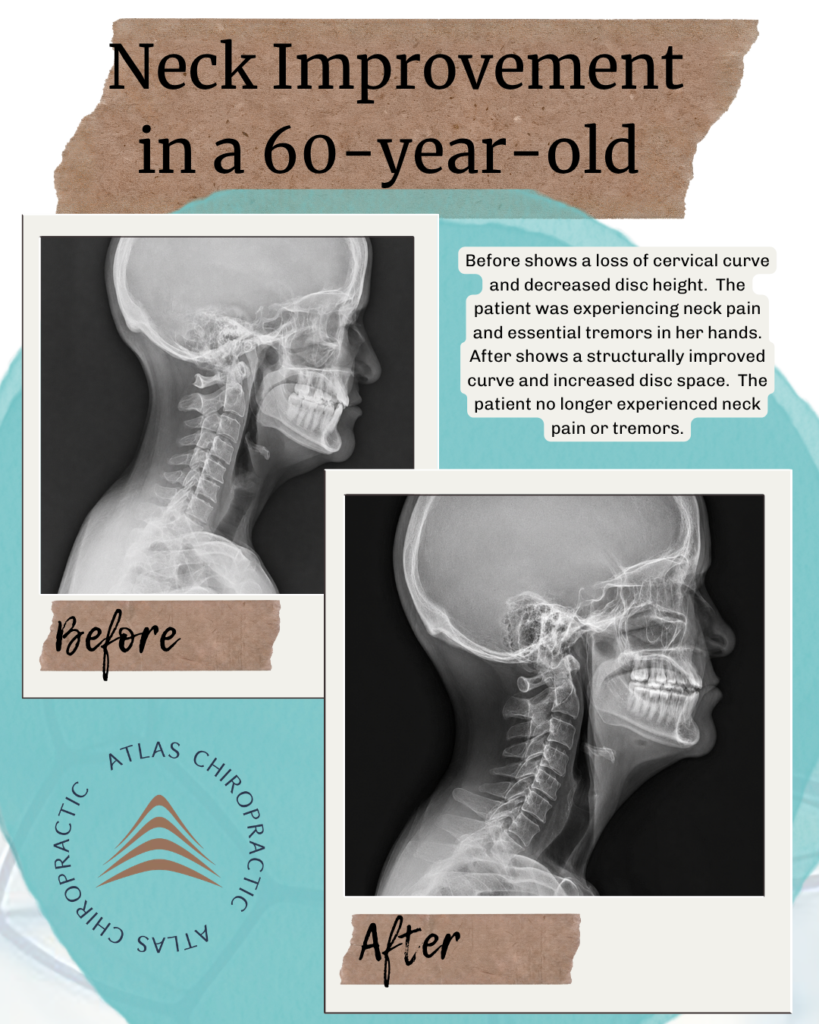
The following image is a case study of a 60-year-old woman who came into our clinic complaining of neck pain and tremors that had been diagnosed as essential tremors by her neurologist. The patient had a history of auto accidents from over two decades ago that had not been rehabilitated properly. We saw that these injuries had caused her neck to decay (atlas misalignment, a loss of proper curve, decreased disc space, and arthritic changes in the bones). Over the course of her care, we were able to restore the cervical curve, get her atlas to set and hold, and increase the disc space. The effect on the patient was that she no longer experienced the neck pain or the tremors and had a greatly improved quality of life.
If you have been wondering whether anything is really changing
If you’ve been wondering about long-term corrective change, that means that you’re someone who wants their health back for real, not just to feel good for the few days after an adjustment.
At Atlas Chiropractic, we typically measure disc height, cervical curve, and motion of the individual vertebra at the 12-month mark. If you have never been assessed and you have been told that your headaches or your neck pain or your dizziness is just something you live with now, that is what our complimentary consultation is for. We will sit down, listen to your history, and tell you honestly whether we believe this work is right for you. If we find we are not the best ones to help you, we will point you toward someone who is.
This is the kind of precise, imaging-based care you would otherwise drive hours to find, and you can get it here, from people who will know your name when you walk in.
Call 254-304-7474 or schedule your complimentary consultation at atlaschiropracticwaco.com.
Reference
Baker S, Alcantara J. Increased Cervical Intervertebral Disc Height Following Blair Upper Cervical Chiropractic Care: A Retrospective Radiographic Review. Journal of Upper Cervical Chiropractic Research. 2026;8-17.
Reviewed by Dr. Christy Flick, DC · Last reviewed August 2026
This article is for educational purposes and shares general information about upper cervical chiropractic care. It isn’t a substitute for an individual clinical assessment, and results vary from person to person. If you’re wondering whether this could be the source of what you’re dealing with, we’d welcome the chance to take a look — schedule a complimentary consultation at atlaschiropracticwaco.com or call 254-304-7474.
About the Author